
The Tannenbaum & Schmidt Continuum: Authority, Freedom, and Everything Between
Why the most effective leaders are those who can shift seamlessly along the line between direction and delegation.

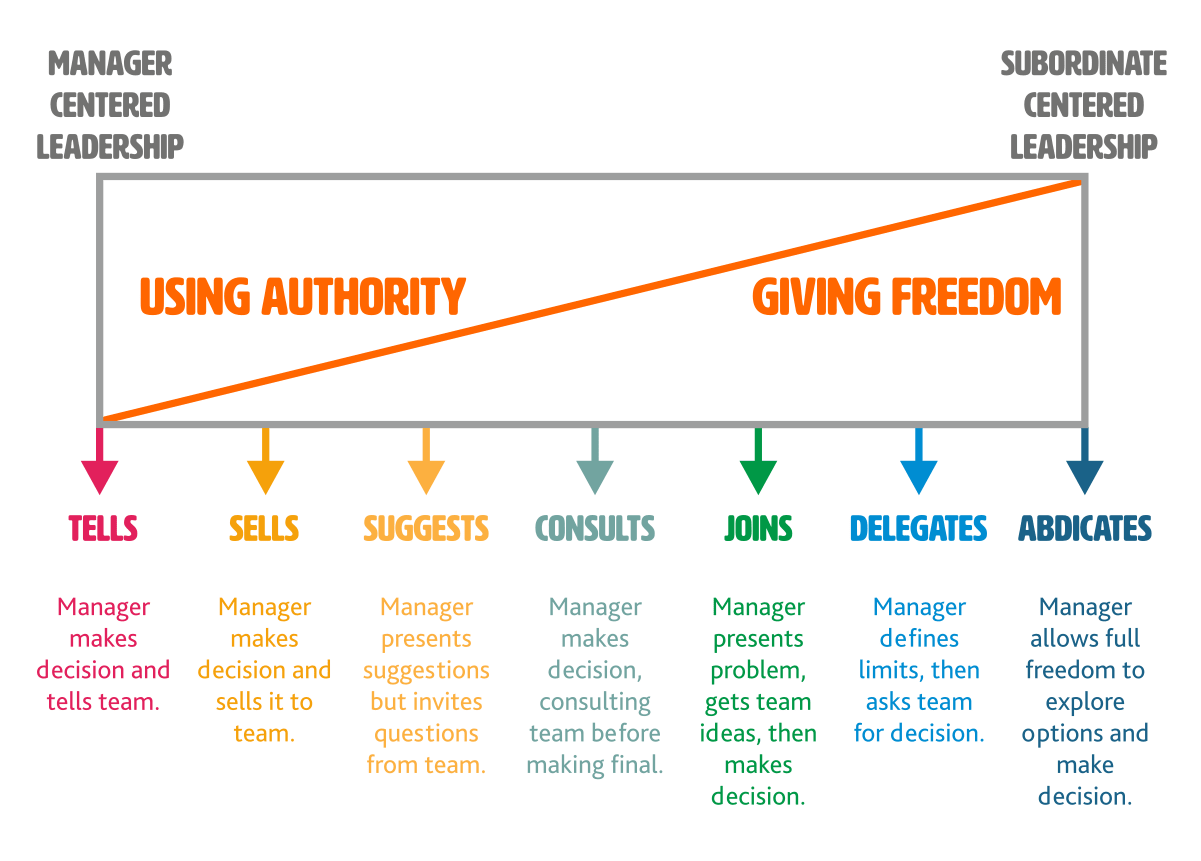
Image from MTD Training Website
Leadership has always been a balancing act between control and collaboration. Some leaders prefer to direct every detail, while others trust their teams to chart their own paths. In 1958, Robert Tannenbaum and Warren H. Schmidt proposed a framework that captured this delicate balance. The Tannenbaum & Schmidt Continuum describes how leaders can adjust their behaviour depending on circumstances, team maturity, and organisational needs. It remains one of the most insightful models for understanding the flexibility required in effective leadership.
Understanding the Continuum
The Tannenbaum & Schmidt Continuum represents a spectrum of leadership styles, ranging from autocratic to democratic. At one end, the leader retains full control, making decisions without consultation. At the other end, authority is delegated entirely, allowing subordinates to make decisions independently. Between these two extremes lies a range of intermediate styles that blend varying degrees of authority and participation.
This model recognises that leadership is not a fixed trait but a dynamic behaviour. Leaders must adapt their approach depending on the situation. Factors such as time constraints, complexity of the decision, and team competence all play a role in determining where along the continuum a leader should operate.
The Seven Stages of Leadership Behaviour
Tannenbaum and Schmidt identified seven distinct levels along the continuum. Each level reflects a different balance between leader authority and subordinate freedom.
Telling – The leader makes the decision and announces it to the team. This style is direct and efficient but allows little room for input.
Selling – The leader makes the decision but explains the reasoning behind it to gain acceptance. It combines authority with persuasion.
Suggesting – The leader presents ideas and invites questions or limited discussion. Although still directive, it begins to open space for dialogue.
Consulting – The leader proposes a tentative decision and seeks feedback before finalising it. Subordinates feel their opinions matter, though the final choice remains with the leader.
Joint Decision – The leader presents the problem, encourages suggestions, and then decides based on collective input. Decision-making becomes more collaborative.
Delegating within Limits – The leader defines boundaries and allows the team to decide within those parameters. Authority is shared, and responsibility grows.
Complete Delegation – The leader entrusts decision-making entirely to the team, intervening only when necessary. This approach suits highly capable and self-directed teams.
Factors Influencing Leadership Choice
Selecting the right style on the continuum depends on multiple factors. A leader must evaluate the situation, such as urgency, stakes, and complexity of the decision. They must also assess team capability - the knowledge, motivation, and readiness of subordinates to take responsibility. Personal factors, including the leader’s confidence and trust in the team, also influence where they operate on the spectrum.
Tannenbaum and Schmidt referred to these as pressures that shape leadership behaviour. Internal pressures stem from the leader’s own values and experience, while external pressures arise from organisational policies, cultural expectations, and time constraints.
The Importance of Flexibility
The key insight of the continuum is that leadership should not be rigid. A highly skilled leader moves fluidly along the continuum, adjusting their style as situations evolve. For example, during a crisis, a more directive approach may be necessary. In contrast, when developing a capable team, a participative style encourages growth and creativity.
Flexibility ensures that leadership remains effective and context-sensitive rather than dogmatic or habitual. It aligns with modern leadership philosophies that emphasise empowerment, trust, and shared accountability.
Practical Applications
The Tannenbaum & Schmidt Continuum finds relevance across industries. In corporate settings, leaders use it to assess their managerial tendencies and adapt to diverse teams. In education and public service, it guides administrators in balancing authority with collaboration. Even in creative industries, the model helps leaders foster innovation without losing focus.
By understanding where they naturally fall on the continuum, leaders can consciously adjust their behaviour to suit their teams and goals.
In conclusion, the Tannenbaum & Schmidt Continuum continues to light the path between authority and freedom in leadership. It reminds us that effective leadership is neither about absolute control nor complete abdication. Instead, it is about knowing when to guide, when to consult, and when to trust others to lead. True leadership, as Tannenbaum and Schmidt suggested, lies in the wisdom to adapt and the courage to share power.
As always, feel free to reach out with any questions or comments. Happy musing!